Oil tank sizes and dimensions
Home oil tank sizes run from about 110 gallons to 1,000, and only a handful of shapes make up almost all of them. Every size below carries its oil tank dimensions, because a tape measure is what settles which tank you have. Buried tanks are here too, with how deep they sit. Each one links to an oil tank size chart that turns an inch of stick into gallons.
If you do not know which tank you have
The tables below run from a size to its numbers. Going the other way, from the tank in front of you to its rating, takes a tape measure, the data plate on the end of the tank, or an old delivery slip, and a buried tank has its own routes. Those routes are on what size is my oil tank. Come back here once you have a size.
Above-ground oil tank sizes: 275 and 330 gallon
Nearly every above-ground tank in a basement or a side yard is a welded steel oval rated 275 or 330 gallons, and each is built in two orientations. Vertical puts the tall side of the oval upright, so the oil reads on a 44 inch scale. Horizontal lays the same tank over on its side, so the identical nominal size reads on a 27 inch scale.
| Tank | Width | Height | Length | Nominal | Full (computed) | Stick range | Chart |
|---|---|---|---|---|---|---|---|
| 275 gallon vertical | 27″ | 44″ | 60″ | 275 gal | 274 gal | 1″ to 44″ | 275 gallon vertical chart |
| 275 gallon horizontal | 44″ | 27″ | 60″ | 275 gal | 274 gal | 1″ to 27″ | 275 gallon horizontal chart |
| 330 gallon vertical | 27″ | 44″ | 72″ | 330 gal | 329 gal | 1″ to 44″ | 330 gallon vertical chart |
| 330 gallon horizontal | 44″ | 27″ | 72″ | 330 gal | 329 gal | 1″ to 27″ | 330 gallon horizontal chart |
Computed from nominal tank geometry at 231 cubic inches per gallon, with a 2.2 percent dished-head allowance calibrated to the manufacturer’s published capacity chart. Matches the chart books oil dealers use within about a gallon. Width is the oval end, height the stick dimension on a vertical tank, length the barrel. Granby publishes the same exterior dimensions for its standard UL 80 tanks in these sizes.
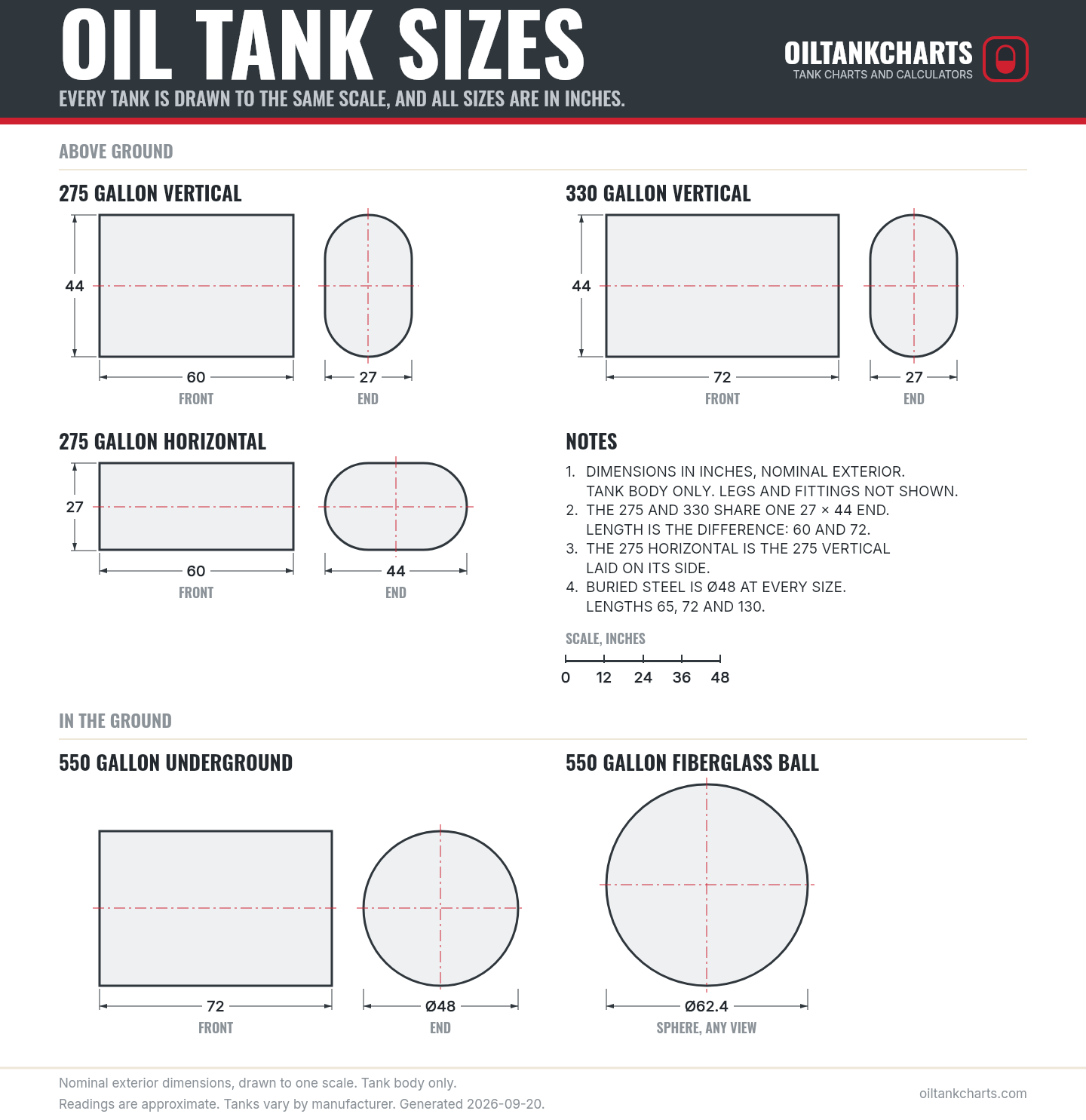
The 275 and the 330 vertical both measure 27 inches across the oval and 44 inches tall, and both read on the same 44 inch stick scale. Length is the measurement that separates them: 60 inches against 72.
Three different numbers describe the capacity of one tank, and they are easy to mix up. Nominal is the size on the data plate and on your delivery paperwork, 275 or 330. Computed full is what the geometry holds, 274 gallons on a 275 and 329 on a 330. Realistic fill is lower again, because a tank is filled to about 95 percent so warming oil has room to expand, and the vent whistle can stop the driver sooner. The longer version is on why a 275 tank holds about 240.
An inch of stick is not worth the same everywhere in the tank. On a 275 vertical the bottom inch is about 2 gallons, because the tank is curving in down there. A 275 horizontal reads about 6 gallons in its bottom inch, since the oil spreads across a wider floor. So each orientation gets its own chart instead of one shared rule of thumb.
Underground oil tank sizes and how deep they sit
Buried steel tanks are cylinders lying on their side, and all three common sizes are 48 inches in diameter. Only the length changes, and on a buried tank the length is the one measurement you cannot see. Fiberglass ball tanks are a separate family, true spheres, and common on Long Island.
| Tank | Diameter | Length | Nominal | Full (computed) | Stick range | Chart |
|---|---|---|---|---|---|---|
| 500 gallon buried | 48″ | 65″ | 500 gal | 509 gal | 1″ to 48″ | 500 gallon underground chart |
| 550 gallon buried | 48″ | 72″ | 550 gal | 564 gal | 1″ to 48″ | 550 gallon underground chart |
| 1000 gallon buried | 48″ | 130″ | 1000 gal | 1018 gal | 1″ to 48″ | 1000 gallon underground chart |
Computed from nominal tank geometry at 231 cubic inches per gallon. Actual tanks vary by manufacturer; cross-check your tank data plate.
Buried cylinders are the one place where the computed number lands above the nominal rating: 509 gallons against 500, 564 against 550, 1018 against 1,000. Read nominal as the name the trade uses and the chart as the geometry. Neither one is the number of gallons a delivery will put in, which is always less.
| Ball tank | Diameter | Nominal | Full (computed) | Stick range |
|---|---|---|---|---|
| 285 gallon fiberglass ball | 50.1″ | 285 gal | 285 gal | 1″ to 50″ |
| 550 gallon fiberglass ball | 62.4″ | 550 gal | 551 gal | 1″ to 62″ |
| 1000 gallon fiberglass ball | 76.1″ | 1000 gal | 999 gal | 1″ to 76″ |
Ball diameters are the sphere itself; the stick range is the readable depth on the fiberglass ball tank chart, which is the diameter rounded down to a whole inch. All three balls read deeper than a buried steel cylinder, which stops at 48 inches no matter how long it is: even the smallest ball reads about 50 inches full.
Burial depth has two answers: what the fire code requires for a new tank, and what is already in the ground. For a new installation the fire code floor is 24 inches of earth over the top of the tank where no vehicle drives over it, or 12 inches of earth plus a 4 inch reinforced concrete slab. Under a driveway it rises to 36 inches of earth, or 18 inches of well tamped earth plus 6 inches of reinforced concrete or 8 inches of asphaltic concrete. Where paving is part of that protection it has to run at least 12 inches past the outline of the tank in every direction. Local rules can be stricter, so the town has the last word.
What is actually in the ground is often shallower, and sometimes shallower than today's floor, because older tanks went in under older rules or none. Contractors who dig them for a living report 2 to 3 feet of soil over the top as typical, with 2 feet the most common, and 1 to 3 feet on residential jobs. On most houses the top of the tank is less than 4 feet down. There is no single code maximum: maximum burial depth is set by the tank maker and marked on the tank, and one fiberglass tank line caps it at 7 feet from the top of the tank to grade.
Small oil tank sizes: 120 to 240 gallon
Below the 275 sits a family of shorter steel ovals for a crawl space, a tight utility room, or a pair of tanks piped together. Granby lists four of them, and all four use one of two end profiles. The 120 and the 240 have a slim 23 by 46 inch end. The 138 and the 220 use the same 27 by 44 inch oval as the 275 and the 330. Inside each pair, length is what changes.
| Size | Height | Width | Length | Listed weight | Granby model | Orientations |
|---|---|---|---|---|---|---|
| 120 gallon | 46″ | 23″ | 30″ | 155 lb | 209101 | Vertical only |
| 138 gallon | 44″ | 27″ | 30″ | 160 lb | 208101 | Vertical or horizontal |
| 220 gallon | 44″ | 27″ | 48″ | 215 lb | 207101 | Vertical only |
| 240 gallon | 46″ | 23″ | 60″ | 245 lb | 202201 | Vertical or horizontal |
Dimensions, listed weight and model numbers from Granby's published model table for its standard UL 80 tanks. The vertical figures are shown; the horizontal versions of the same tanks keep the length and swap the published height and width.
Granby's vertical capacity chart covers 120, 138, 220, 230, 240, 275 and 330. The 230 is a charted size that Granby no longer publishes dimensions for, so there is nothing honest to put in a dimensions row for it. The chart itself, with Granby's own note that it is good to about plus or minus 2 percent and is not meant for buying or selling fuel, is on the Granby tank sizes page.
There is no 250 in Granby's list, and no 250 in any table on this page. What people usually mean when they call a tank a 250 is on the 250 gallon oil tank page.
There are small double-wall tanks too: the Roth 400L at about 110 gallons and the 620L at 165, both in the Roth table below.
Double-wall tank sizes (Roth)
A double-wall tank is a plastic inner tank inside a leak-proof steel outer shell, so the containment is built in rather than added under the tank. Roth's EcoDWT plus 3 line is the double-wall family this site carries a chart for, and Roth names its tanks in liters.
A Roth 400L holds about 110 US gallons, not 400. The 620L holds 165. The Roth that actually holds 400 gallons is the 1500L. Roth's own paperwork adds to the trouble: the 620L submittal sheet describes the tank as 165 gallons and 620 liters on one line, then prints 165 (1000) in the spec table just below it, and that 1000 is simply wrong. Read the gallon figure off the label on the tank, and treat the liter number in the model name as a name rather than a measurement.
| Model | Nominal | Length | Width | Height | Min. clearance | Listed weight |
|---|---|---|---|---|---|---|
| Roth 400L | 110 gal | 29″ | 28″ | 44″ | 49″ | 106 lb |
| Roth 620L | 165 gal | 29″ | 28″ | 61″ | 66″ | 132 lb |
| Roth 1000L | 275 gal | 43″ | 28″ | 61″ | 66″ | 167 lb |
| Roth 1000LH | 275 gal | 51″ | 30″ | 54″ | 60″ | 208 lb |
| Roth 1500L | 400 gal | 64″ | 30″ | 68″ | 76″ | 333 lb |
Exterior dimensions from Roth's EcoDWT plus 3 spec sheets, the same table the Roth tank sizes and chart page carries. Minimum clearance is the vertical room needed to stand a tank up during installation, which is what decides a low basement, not the tank height.
Two models share the 275 gallon rating in different bodies: the tall 1000L and the low, wide 1000LH. Roth's fill chart is already a 95 percent chart, so its top row is a fill limit. The steel charts on this site top out at computed full, which is a geometric number. Same tank rating, two different kinds of top row.
Oil tank measurements beyond length and width: steel thickness and empty weight
Granby builds its standard residential tanks from 12 gauge steel, in every size from the 120 through the 330, and lists them to UL 80. A heavier 10 gauge version of the 275 is sold as an option, so 12 gauge is the norm and 10 gauge is the upgrade. Gauge is how the trade states thickness and how the manufacturer prints it.
Weight matters when you are planning a swap or measuring a basement doorway. Granby lists the 275 at 250 pounds and the 330 at 290 pounds in 12 gauge, and the 10 gauge 275 at 330 pounds, which is 80 pounds of extra steel in the same size tank. The small sizes are lighter: 155 pounds for the 120, 160 for the 138, 215 for the 220 and 245 for the 240. Those figures are the tank by itself with no oil in it. A tank with oil in it weighs several times that, so nobody moves one until it is empty.
Construction, as Granby publishes it: pressure tested at 5 PSIG, for operation at atmospheric pressure only, with a black powder coat outside. UL 80 is the listing standard those tanks carry. This page does not state what UL 80 requires as a minimum wall thickness, because the standard is not free to read.
Which size tank do you need?
Sizing a replacement is a question about how much oil you burn, not about which tank fits the hole the old one left. Run your yearly gallons through the tank sizing calculator and it returns a size and how many fills a winter that means.
A bigger tank does not burn less oil; it changes how often the truck comes and how much oil you pay for at once. And in a finished basement the doorway, the headroom and the clearance to stand the tank up often decide the answer before capacity does. The Roth table above has a clearance column for that reason.
Common questions
What are the dimensions of a 275 and a 330 gallon tank?
In the vertical versions both stand 44 inches tall and 27 inches across the oval end; the 275 is 60 inches long and the 330 is 72. The horizontal versions are published the other way round, 27 inches tall and 44 across, so they read on a 27 inch stick scale instead of 44. The 275 vertical chart and 330 vertical chart carry the inch by inch gallons.
What are the standard underground oil tank sizes?
Buried residential steel tanks are 48 inch diameter cylinders in 500, 550 and 1000 gallon ratings, differing only in length: 65, 72 and 130 inches. Fiberglass ball tanks come in 285, 550 and 1000 gallon sizes, at diameters of about 50, 62 and 76 inches. The buried tank size calculator sorts out which one you have.
How many gallons is a Roth 400L?
About 110 US gallons nominal, not 400. Roth names its tanks in liters, so the model number is a name rather than a capacity, and the Roth that holds 400 gallons is the 1500L. The Roth tank sizes and chart page lists every model with its gallons.
How much does an empty oil tank weigh, and how thick is the steel?
Granby lists its 12 gauge 275 at 250 pounds and the 330 at 290 pounds, with the small sizes from 155 pounds (120 gallon) to 245 (240 gallon). Those are the bare tank with no oil in it. Standard residential tanks are 12 gauge steel listed to UL 80, with a heavier 10 gauge 275 sold as an option at 330 pounds.
Sources
- Granby Industries, standard residential oil storage tank (UL-80): exterior dimensions, steel gauge, listed tank weights, model numbers, and the sizes offered.
- Granby Industries, capacity chart for US vertical tanks: the charted sizes, including the 230, and Granby's own accuracy note.
- Granby Industries, cylindrical oil storage tank (UL-80): the second 138 gallon tank, 26 inches in diameter.
- Roth America, EcoDWT plus 3 submittal sheets and fill chart: model dimensions, nominal gallons, and the 95 percent fill limit.
- UL 80, Standard for Steel Tanks for Oil-Burner Fuels and Other Combustible Liquids: the listing standard Granby's tanks carry. The standard is not free to read, so no UL 80 requirement is quoted here.
- Minnesota State Fire Code, one state's adoption of the model fire code: the 24 inch cover minimum, the reduced-cover slab option, and the traffic case. Your state's figures may differ.
- Containment Solutions, fiberglass tank installation instructions (INST 6001K, 2021): the 7 foot maximum burial depth on that tank line, and the note that local code can be stricter.
- Field observations of residential burial depth from tank contractors: GreenTRAX and CommTank. These are what crews find, not code minimums.
Full and stick figures in the tables are this site's own computed charts, generated from the dimensions shown; each chart page prints its method. Your tank's data plate outranks everything here.
Related
Last updated