Reading an oil tank gauge
The gauge on top of your oil tank is a float on a hinged arm, and its fractions measure oil depth, not gallons. The difference shows up most at 1/4, when you are deciding whether to order. The table below converts each mark to gallons on a 275.
To read an oil tank gauge, look at the disc in the clear vial on top of the tank and note its mark: F, 3/4, 1/2, 1/4 or E. Those marks are depth fractions, not gallons. On a 275 vertical, 1/2 is about 137 gallons and 1/4 about 58, because the tank holds less per inch near the bottom.
How the float gauge works
Inside the tank, a float rides on the oil surface at the end of a hinged arm. As the level falls, the arm pivots and moves an indicator disc inside the clear vial on top of the tank, past marks for F, 3/4, 1/2, 1/4, and E. Nothing in it is electric, so there is no battery and nothing to calibrate.
That is the gauge this page covers. If your reading comes from somewhere else, a wall indicator you pump, a phone app, or a float on a string inside a sealed Roth tank, go to the five kinds of tank gauge. That page covers all five, with the tank each one fits.
The marks are level fractions: 1/2 means the oil sits at half the tank's depth. It does not mean half the tank's gallons. In the straight middle of the tank the two track closely; at the curved top and bottom they drift apart.
Gauge marks in gallons on a 275 vertical
| Gauge mark | Oil depth | Gallons on board |
|---|---|---|
| F | near the fill level | typically 240 to 250 |
| 3/4 | 33″ | about 216 |
| 1/2 | 22″ | 137 |
| 1/4 | 11″ | about 58 |
| E | last few inches | a few gallons, below the pickup |
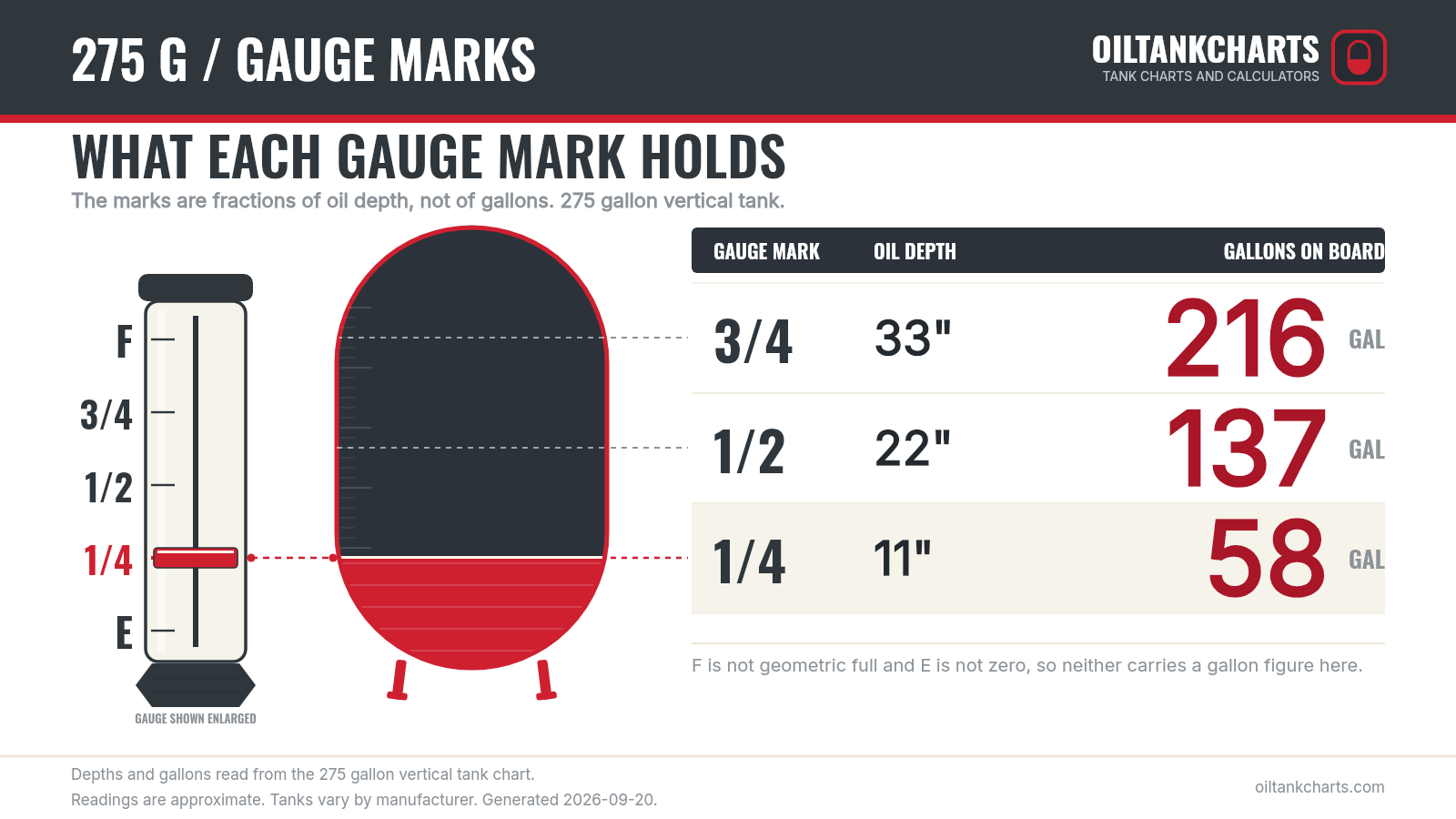
The table has two catches. F is not geometric full: the tank computes to about 274 gallons, but the delivery whistle stops the driver while an air gap remains, so a "full" 275 typically carries 240 to 250 gallons of oil. And E is not zero: a few gallons sit below the outlet pickup where the burner cannot draw them. More on both in why a 275 holds about 240.
Why 1/4 is less than a quarter tank
Gauge 1/4 on a 275 vertical is about 58 gallons. A true quarter of the tank's 274 gallon computed capacity would be 69. The difference is the tank's curved bottom: the lowest inches hold less oil per inch than the straight middle. Split the depth into quarters and the two middle quarters hold about 79 gallons each, while the curved bottom and top quarters hold about 58 each.
When the disc touches 1/4 you have less oil than the fraction suggests, and the level is dropping through the leanest part of the tank. That is when to order oil.
When the gauge lies
- Stuck float. The arm hangs up on sludge or the tank wall and the reading freezes. A gauge that has not moved through weeks of heating is stuck.
- Bent arm. A bent or binding arm reads consistently high or low at every level.
- Fogged vial. Years of oil mist coat the inside of the plastic. The disc is in there somewhere, but you cannot read it.
- Detached disc. The indicator separates from the arm and rests at the bottom of the vial, so it reads empty from then on.
Treat the gauge as a trend indicator. It is good at "lower than last week". When you need a number to order on, measure the tank with a stick. The two minute procedure is in how to stick an oil tank.
Common questions
How do I read an oil tank gauge?
Look at the disc inside the clear vial on top of the tank and note which mark it rests at: F, 3/4, 1/2, 1/4 or E. Those marks are depth fractions, not gallons, so convert with the table above: on a 275 vertical, 1/2 is about 137 gallons and 1/4 about 58. For a number worth ordering on, stick the tank.
My gauge has read the same for weeks. Is it broken?
During the heating season, most likely yes: a float that never moves is usually stuck on sludge or the tank wall. Verify with a stick reading and the chart for your tank. If the stick and the gauge disagree, believe the stick and have the gauge swapped at your next service visit.
How accurate is a float gauge when it works?
Coarse at best. The marks are quarter-tank steps, the fractions measure depth rather than gallons, and the arm geometry adds slack. A healthy gauge tells you which quarter you are in; the stick tells you the gallons.
Why does the gauge seem to fall faster near empty?
The bottom of the tank is curved, so each gallon burned near the bottom drops the level further than a gallon burned mid-tank. On a 275 vertical the bottom quarter of depth holds about 58 gallons against 79 for a middle quarter, so the same burn rate moves the gauge visibly faster.
Can I replace the gauge myself?
The gauge threads into a tapping on top of the tank and the part is inexpensive, but a tapping that is not sealed right will weep oil, and a combined gauge and vent alarm must never be swapped for a plain gauge. Sizing the gauge to your tank depth, that combination trap, and what the job involves are all in replacing an oil tank gauge. A plain gauge is a reasonable homeowner job as long as the float is held all the way up going in and the threads get an oil-rated pipe dope; have the delivery driver check the tapping on the next visit.
Related
- How to stick an oil tank
- Petrometer pump-style gauges (the wall-mounted kind with the plunger)
- No gauge at all? How to track oil anyway
- 275 gallon vertical tank chart
- Why a 275 tank holds about 240
- How long will my oil last?
- WiFi and smart oil tank gauges, for when the float gauge is not enough
- Oil tank reading for a closing
Last updated