Fiberglass ball oil tank chart
Buried fiberglass ball tanks, many of them built by Cardinal Fiberglass in Brooklyn, sit under yards all over Long Island and the New York area. They are true spheres, read through the fill pipe like any buried tank, but a sphere fills nothing like a cylinder: the middle inches carry far more oil than the top and bottom. Use the chart for your ball size, not a cylinder chart.
Which ball do I have?
The label and the measured depth often disagree on these tanks, so trust the stick: a full ball that reads about 50 inches is the 285, about 62 inches is the 550, and about 76 inches is the 1000. A ball in the five foot range is the 550, even though plenty of them get remembered as thousand gallon tanks. Installation records or the original permit settle it for certain, and the buried tank sticking procedure applies as written.
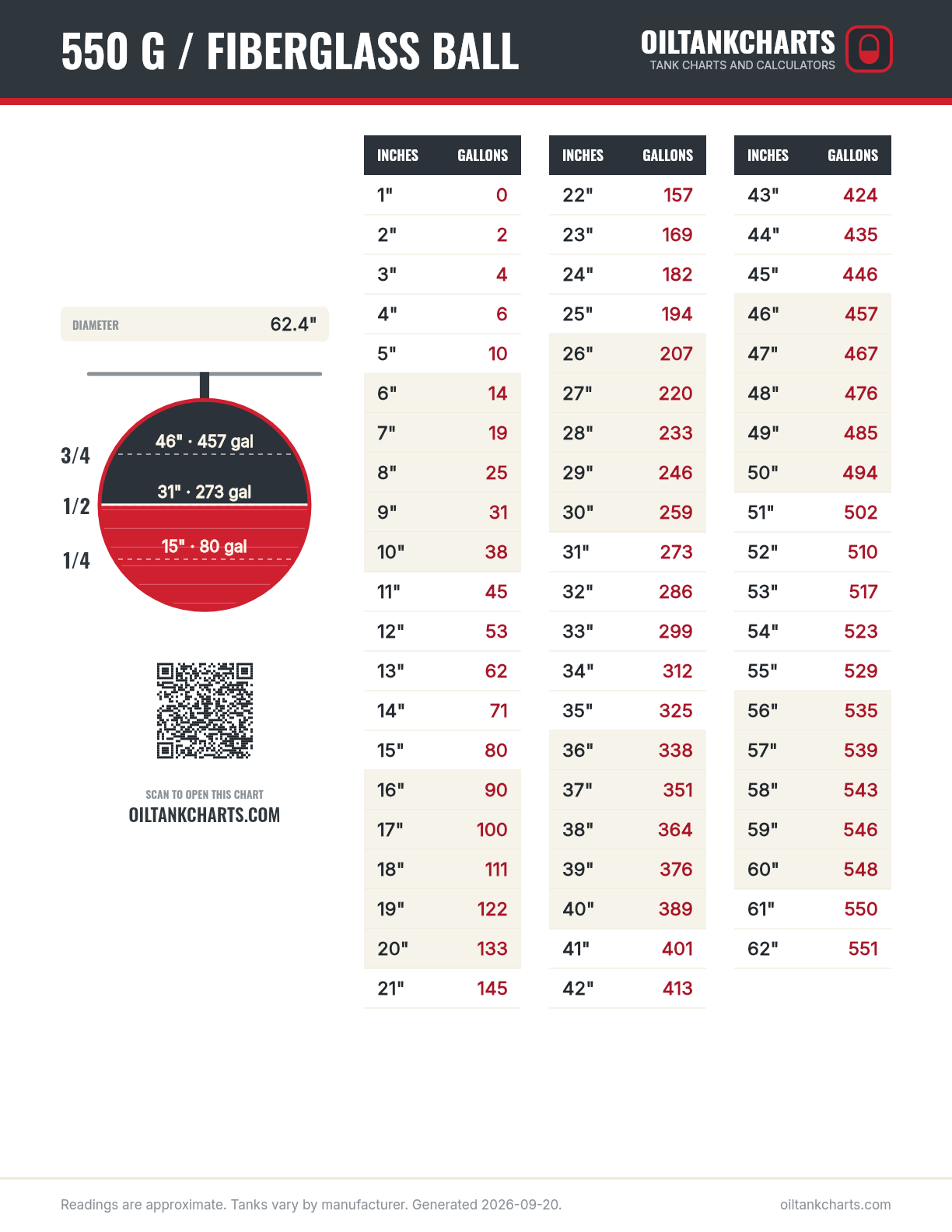
550 gallon ball (about 62″ across)
The most common residential size. Half full reads about 31 inches, 273 gallons on the chart.
Type a reading, or drag the level ↕
| Inches | Gallons | Inches | Gallons |
|---|---|---|---|
| 1″ | 0 | 32″ | 286 |
| 2″ | 2 | 33″ | 299 |
| 3″ | 4 | 34″ | 312 |
| 4″ | 6 | 35″ | 325 |
| 5″ | 10 | 36″ | 338 |
| 6″ | 14 | 37″ | 351 |
| 7″ | 19 | 38″ | 364 |
| 8″ | 25 | 39″ | 376 |
| 9″ | 31 | 40″ | 389 |
| 10″ | 38 | 41″ | 401 |
| 11″ | 45 | 42″ | 413 |
| 12″ | 53 | 43″ | 424 |
| 13″ | 62 | 44″ | 435 |
| 14″ | 71 | 45″ | 446 |
| 15″ | 80 | 46″ | 457 |
| 16″ | 90 | 47″ | 467 |
| 17″ | 100 | 48″ | 476 |
| 18″ | 111 | 49″ | 485 |
| 19″ | 122 | 50″ | 494 |
| 20″ | 133 | 51″ | 502 |
| 21″ | 145 | 52″ | 510 |
| 22″ | 157 | 53″ | 517 |
| 23″ | 169 | 54″ | 523 |
| 24″ | 182 | 55″ | 529 |
| 25″ | 194 | 56″ | 535 |
| 26″ | 207 | 57″ | 539 |
| 27″ | 220 | 58″ | 543 |
| 28″ | 233 | 59″ | 546 |
| 29″ | 246 | 60″ | 548 |
| 30″ | 259 | 61″ | 550 |
| 31″ | 273 | 62″ | 551 |
Tap any row to send that reading to the gauge above.
Generated 2026-09-20. Computed from spherical geometry at 231 cubic inches per gallon; agrees with published spherical gauge charts within a gallon. Confirm your ball diameter against installation records.
Preview the printable sheet
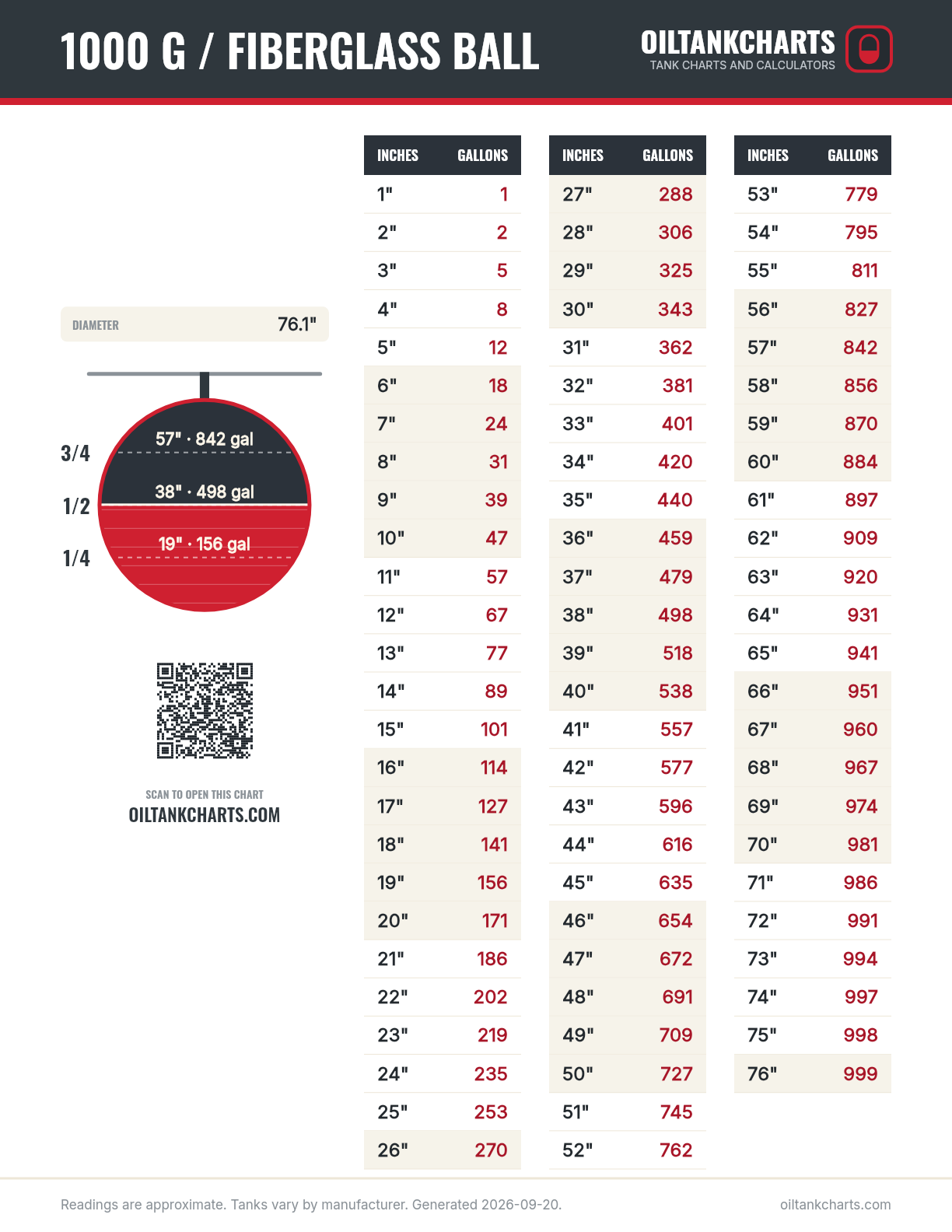
1000 gallon ball (about 76″ across)
This is the big one, often at larger or two family homes. The middle is steep: from 30 to 46 inches the tank moves close to 19 gallons per inch.
Type a reading, or drag the level ↕
| Inches | Gallons | Inches | Gallons |
|---|---|---|---|
| 1″ | 1 | 39″ | 518 |
| 2″ | 2 | 40″ | 538 |
| 3″ | 5 | 41″ | 557 |
| 4″ | 8 | 42″ | 577 |
| 5″ | 12 | 43″ | 596 |
| 6″ | 18 | 44″ | 616 |
| 7″ | 24 | 45″ | 635 |
| 8″ | 31 | 46″ | 654 |
| 9″ | 39 | 47″ | 672 |
| 10″ | 47 | 48″ | 691 |
| 11″ | 57 | 49″ | 709 |
| 12″ | 67 | 50″ | 727 |
| 13″ | 77 | 51″ | 745 |
| 14″ | 89 | 52″ | 762 |
| 15″ | 101 | 53″ | 779 |
| 16″ | 114 | 54″ | 795 |
| 17″ | 127 | 55″ | 811 |
| 18″ | 141 | 56″ | 827 |
| 19″ | 156 | 57″ | 842 |
| 20″ | 171 | 58″ | 856 |
| 21″ | 186 | 59″ | 870 |
| 22″ | 202 | 60″ | 884 |
| 23″ | 219 | 61″ | 897 |
| 24″ | 235 | 62″ | 909 |
| 25″ | 253 | 63″ | 920 |
| 26″ | 270 | 64″ | 931 |
| 27″ | 288 | 65″ | 941 |
| 28″ | 306 | 66″ | 951 |
| 29″ | 325 | 67″ | 960 |
| 30″ | 343 | 68″ | 967 |
| 31″ | 362 | 69″ | 974 |
| 32″ | 381 | 70″ | 981 |
| 33″ | 401 | 71″ | 986 |
| 34″ | 420 | 72″ | 991 |
| 35″ | 440 | 73″ | 994 |
| 36″ | 459 | 74″ | 997 |
| 37″ | 479 | 75″ | 998 |
| 38″ | 498 | 76″ | 999 |
Tap any row to send that reading to the gauge above.
Generated 2026-09-20. Computed from spherical geometry at 231 cubic inches per gallon; agrees with published spherical gauge charts within a gallon. Confirm your ball diameter against installation records.
Preview the printable sheet
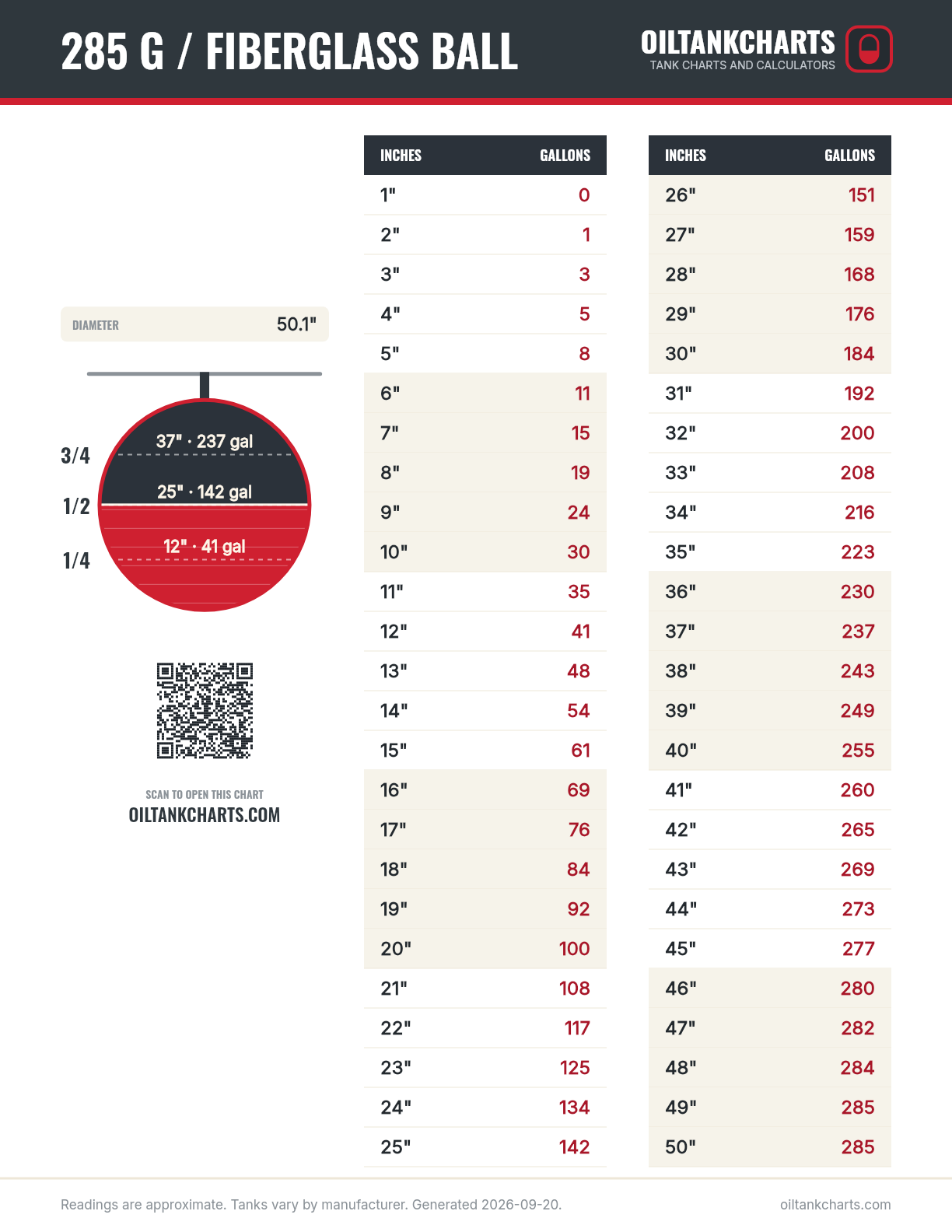
285 gallon ball (about 50″ across)
Type a reading, or drag the level ↕
| Inches | Gallons | Inches | Gallons |
|---|---|---|---|
| 1″ | 0 | 26″ | 151 |
| 2″ | 1 | 27″ | 159 |
| 3″ | 3 | 28″ | 168 |
| 4″ | 5 | 29″ | 176 |
| 5″ | 8 | 30″ | 184 |
| 6″ | 11 | 31″ | 192 |
| 7″ | 15 | 32″ | 200 |
| 8″ | 19 | 33″ | 208 |
| 9″ | 24 | 34″ | 216 |
| 10″ | 30 | 35″ | 223 |
| 11″ | 35 | 36″ | 230 |
| 12″ | 41 | 37″ | 237 |
| 13″ | 48 | 38″ | 243 |
| 14″ | 54 | 39″ | 249 |
| 15″ | 61 | 40″ | 255 |
| 16″ | 69 | 41″ | 260 |
| 17″ | 76 | 42″ | 265 |
| 18″ | 84 | 43″ | 269 |
| 19″ | 92 | 44″ | 273 |
| 20″ | 100 | 45″ | 277 |
| 21″ | 108 | 46″ | 280 |
| 22″ | 117 | 47″ | 282 |
| 23″ | 125 | 48″ | 284 |
| 24″ | 134 | 49″ | 285 |
| 25″ | 142 | 50″ | 285 |
Tap any row to send that reading to the gauge above.
Generated 2026-09-20. Computed from spherical geometry at 231 cubic inches per gallon; agrees with published spherical gauge charts within a gallon. Confirm your ball diameter against installation records.
Preview the printable sheet
Common questions
Is my buried tank a ball or a cylinder?
Measure a full tank. Steel cylinders run 48 inches deep regardless of length; balls read about 50, 62, or 76 inches full. Fiberglass balls also typically have a single fill at the crown, and installation records or the permit will name the tank. If the numbers are ambiguous, ask your oil company to gauge it at the next delivery.
Do fiberglass tanks have the same water problem as steel?
Fiberglass does not rust, which is why so many of these survive decades underground. Water can still get in through a loose fill cap and sit under the oil, so the water finding paste check in the sticking guide is still worth doing once a season.
My full reading does not match any of these sizes.
A tilted tank, a fill pipe that enters off center, or a nonstandard ball will throw the scale off. Run your own numbers through the heating oil tank calculator using the ball option and your measured full depth as the diameter.
Whose chart is this?
It is computed from spherical geometry, which is the same math behind the gauge charts the fiberglass makers publish; we cross checked against a published spherical gauge chart and agree within a gallon at every depth. It applies to any true spherical tank, Cardinal or otherwise.
Related
Last updated